Free Guide
Improve Your Well Intervention Planning?
- 12 questions you need to consider
Executive Summary
This paper explains what you can do to improve how you plan your Well Intervention Operations.
Well interventions are becoming an increasing focus for energy companies seeking to maximise production from existing wells, especially as environmental concerns make drilling new wells less desirable. Planning these interventions is still often a manual task. This paper examines how digitalising the process can reduce planning time and significantly decrease errors caused by using unapproved data.
Several methods can help improve Well Intervention planning:
-
Continuous Improvement Cycles: Connecting plans to executions and capturing experiences for use in future plans enables reliable efficiency gains that can be repeated over time.
-
Digital Work Processes: Implementing digital work processes offers benefits such as consistent plans, progress monitoring, automation, transparency, and efficient retrospectives.
-
Collaborative solutions: Collaborative platforms support effective communication and better teamwork across disciplines and companies, making it easier to work together in a streamlined and intuitive way.
The final section includes a checklist designed to help you reflect on your current ways of working and identify common signs that indicate opportunities for improvement.
Table of Contents
About the author
CHRISTOFFER SORENSEN
Christoffer is the Sales & Marketing Director in Stimline and has been involved in the Well Intervention industry since 2012.
Having first started as a Coiled Tubing Field Engineer for Schlumberger, Christoffer has been involved in all stages of planning, executing and evaluating intervention jobs both in the field and in client offices.
Christoffer’s passion for new technology and innovative solutions has seen him setting records in the North Sea and planning world firsts in West Africa. The focus for him now is to continue to understand the challenges that Oil Companies are having and demonstrate how Stimline’s solutions are already delivering value to current customers.

What is Intervention Planning Today?
What is Well Intervention?
Every hydrocarbon-producing field depends on high uptime to deliver value according to a planned depletion strategy. To maintain this required uptime, both producing and injecting wells rely on ongoing maintenance throughout their lifespan, commonly referred to as well intervention.
Well Intervention was once considered a high-risk operation due to low success rates and the high cost of addressing any issues that arose. However, the industry is undergoing a transition. Operators are now demanding higher performance as they focus on well intervention for low-cost production improvements, and service companies are increasingly able to deliver reliable and complex solutions to address many intervention challenges.
Today, numerous well intervention methods exist to either increase a well’s productivity or restore it to original levels. The optimal method is often field- or well-specific and may vary depending on the well’s life stage.
Despite these variations, the objectives generally fall into three main categories:
-
Increasing or restoring production
-
Fixing well integrity issues
-
Surveillance
A range of solutions can be deployed to meet these objectives using wireline, tractor, coiled tubing, or hydraulic workover methods. Typical tasks include:
-
Stimulation
-
Setting or pulling of plugs and valves
-
Clearing debris
-
Conducting surveys
-
Logging
-
Scale removal
-
Perforating
-
Cementing, and
-
Fishing
Interventions like these can be complex and time-consuming. The primary goal for intervention teams is to carry them out as quickly as possible while upholding the highest health, safety, and environmental standards. Each well intervention job must therefore be planned in detail before execution to maximise the chance of success.

How is Well Intervention Planning Completed Today?
When planning an intervention operation, many factors need to be evaluated to develop the best plan in terms of cost, time, and risk. The planning team must consider standard operating procedures, job objectives, available tools, conveyance methods, target well details, and the risks associated with different methods. They also need to draw on experience from past similar operations.
Currently, the intervention team gathers relevant data for the well and manually creates a set of ranked and rated plans. These plans help identify the most effective option with the highest likelihood of success. This process is iterative and involves many stakeholders, which means frequent meetings and continuous follow-up are required to communicate new information as it becomes available.
The well intervention plans typically include:
-
A job summary, including the number of runs required, estimated run duration, and total job duration
-
A detailed job procedure in line with company requirements
-
An estimated relative total cost for the operation (P10, P50, P90)
-
Bottom Hole Assembly (BHA) tool details and cable or coiled tubing specifications
-
A summary of simulation results, such as tubing forces and hydraulics analyses, demonstrating that the job can be reliably and safely completed
-
All relevant risk factors with associated mitigation and prevention actions
-
Any relevant lessons learned from previous jobs
Collecting this volume of information from diverse data sources, often spread across departments, makes the task time-consuming. Once all the necessary information has been aggregated, the team can prepare a step-by-step procedure for the operational team to execute in order to deliver the well objectives.
Check out this guide: Traditional vs. Digital Intervention Planning - 6 questions to consider before selecting a digital platform
Why is Well Intervention Planning Important?
Until recently, the industry has regarded improved drilling methods, advanced reservoir modelling, and production optimization technologies as the principal cost drivers in oil and gas operations. As a result, many efforts to achieve production gains have focused on these areas.
In recent years, however, some energy companies have discovered significant untapped opportunities in well intervention. New software tools and a more data-driven approach to managing operations have made it possible to improve collaboration during planning and execution, capture essential lessons, integrate data streams, and formalize best practices. These enhancements help companies optimise performance during well interventions and minimise the time a well is out of production.
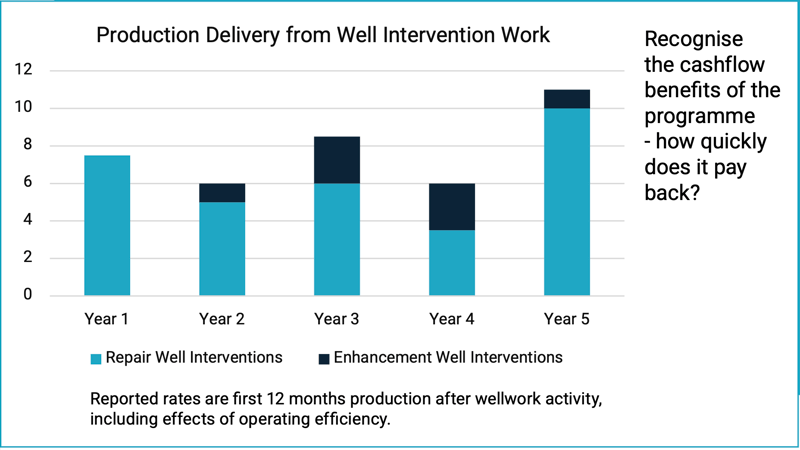
A presentation at an Intervention & Coiled Tubing Association (ICoTA) meeting in Aberdeen illustrated this trend. It described how a North Sea operator developed and implemented more effective intervention strategies to enhance performance. Over several years, despite falling oil prices, the operator conducted an increasing number of well intervention jobs in the North Sea.

The complexity of the well tasks also grew. While repair work remained an important part of the strategy, the company placed much greater emphasis on enhancement jobs (Figure 1).
This focus on maximising the value of existing assets helped the operator significantly reduce production deferrals over four years. They attributed their success to:
-
Detailed tracking of performance enhancements
-
A simplified workflow that reduced the time engineers spent chasing paper
-
Effective methods to capture important lessons
-
The establishment of a regional well intervention team
If energy companies and service companies can dramatically reduce well intervention planning time, this will directly lower associated costs, increase productivity, and support the creation of fit-for-purpose well intervention plans.
Have a look at this guide: Traditional vs. Digital Drilling Operations - 6 questions to consider before selecting a digital platform
Alternative Methodology for Intervention Planning
Data-Driven Intervention Planning
Many oil and gas wells have long and complex histories. Over their lifetime, wells may undergo several interventions delivered by different service companies and crews, each planned by different engineers. Understanding and documenting these changes—whether related to structural modifications, adjustments to the operating envelope, or shifts in production potential—is essential.
Access to information from earlier interventions allows operators to understand the current condition of the well, predict the impact of planned changes, and determine which intervention tools or strategies are likely to be most cost-effective.
When historical data is not readily available, the operator’s team may spend significant time locating it. Until now, teams involved in planning and executing well intervention jobs have often had to manually retrieve information about past work and search for reports to remind themselves what was done, why it was done, and what the outcome was. Once the data was collected, they then had to determine what was relevant to the job being planned.
Some energy companies are now exploring the application of new digital technologies to their well interventions. They are actively collecting and storing production and intervention data to evaluate whether this approach can streamline future planning and, ultimately, optimise long-term production. Achieving these operational benefits depends on having access to high-quality data that can be shared across disciplines, replacing traditional data sources that are frequently outdated, misplaced, or forgotten.
The goal is to optimise intervention jobs by reducing planning time and ensuring that the correct method is selected. To make this possible, teams need the ability to collate and analyse data from previous jobs, and to capture and store the experiences of asset teams, crews, and service companies relevant to the well, field, or region. Having these data available from a reliable and easily accessible source enables companies to better understand the challenges they face, plan more effectively, and optimise the execution of future intervention jobs.
A systematic approach to capturing and using well intervention data allows companies to replicate successful strategies and benefit from them over the life of an asset. Bringing data and analytical tools into a single integrated package is an important first step toward optimising performance in this critical area.
Today, operators can more easily apply digital technologies and take full advantage of Cloud-based data storage and sharing. Greater data availability, the rise of powerful commercial visualization tools, and secure browser-based access mean that efficiency improvements can now be achieved at a much lower cost.

The Digitalization of Work Processes
While manual work processes, often combined with digital databases, can ensure systematic and controlled data collection, a fully digital solution with an embedded workflow tool can save time and reduce the risk of human error.
A workflow defines the steps involved in completing a task. In the context of planning well intervention operations, the workflow represents the sequence of activities that must be completed in a specific order to produce an execution-ready plan.
Workflows help ensure that important processes are carried out correctly and consistently. Because the workflow is clear and visible, it helps all team members understand the process, making planning more efficient. It also enables newer team members to quickly grasp what needs to be done, identify missing steps, and recognise issues within the planning process.
Immediate access to information increases transparency within an organisation and empowers employees to make data-driven decisions. Digital workflows also make it possible to assign tasks and monitor progress, which can improve accountability and reduce the need for micromanagement. This increased transparency can lead to better communication among team members.
The traditional paper trail associated with manual planning, often time-consuming to manage, can now be replaced with a digital trail that clearly shows the record of decisions, actions taken, and the entire timeline for efficient retrospectives. This enables teams to automate a significant portion of their work, including approvals and notifications.
A Collaborative End-to-End Solution
Good intervention planning lays the foundation for excellent execution. Planning itself is strengthened by lessons and experience gained from previous operations, especially when those successes and failures are effectively analysed. As you know, planning is not an isolated task; it is part of a continuous cycle of improvement.
Planning solutions can therefore benefit from being built in a way that makes historical data easily accessible while also delivering the information required for execution. This approach makes it possible to quickly find and incorporate lessons learned, and to use insights from previous jobs to produce and refine new digital plans. Planning improves with strong collaboration, and it is an advantage when all stakeholders work effectively as a team to produce the required deliverables. To achieve this, it is essential that every party has access to the information needed to complete their tasks.
Digital collaboration refers to people working together through online tools such as software-as-a-service (SaaS) platforms. Instead of relying solely on in-person communication, teams can use digital tools to meet many of their collaborative needs.
Some organisations use digital collaboration to supplement their day-to-day, onsite operations. Others, such as remote-only teams, depend on it entirely, using video calls, shared documents, and cloud-based project management to operate effectively. This becomes especially important when team members are geographically dispersed. Communication, project and task management, efficient file sharing, auditability, access privileges, and security are all critical components of effective collaboration.
Digital collaboration can help well intervention teams become more organised and productive. Instead of exchanging files by email, teams can track workflows easily within a shared platform. This helps avoid situations where people are unsure whether they are working on the most recent version of a document. A digital collaboration platform also gives all team members and stakeholders a clearer view of the project as a whole.
This type of collaboration is especially valuable for cross-functional teams, groups made up of members from different departments or companies, which is increasingly common in Well Intervention planning. The “One-Team” approach is growing in popularity as operators and service companies expose team members to decisions and areas they were not previously involved in. The aim is to bring teams closer together, ensure all stakeholders are engaged in relevant decisions, and strengthen collaboration at every stage.

Reader's Checklist
So what should you do next? To understand your current level of planning capability, review the checklist below. If many of these points feel familiar, new solutions are available that can improve the well intervention planning workflow in your organisation.
-
Do you collect, review, and manually input well data, such as completion information, well integrity and well trajectory data, and historical production, into multiple applications and software tools?
-
Do you need to continuously update cost and time estimations based on new information that you receive?
-
When preparing the well intervention program and operational checklists, is this a manual copy-and-paste exercise requiring multiple reviews to ensure quality?
-
Do you hold many meetings and write numerous emails to stakeholders, including service providers, internal business units, and other parties?
-
Are you manually copying and documenting all decisions in multiple
apps and emails? -
Have you ever experienced the use of incorrect data during planning, resulting in lost time during execution?
-
Would you say that you lose time tracking and quality checking the source of data used during planning?
-
Is your team good at capturing experiences and lessons learned, but struggles to keep track of them when planning a new operation?
-
Do you depend on version control to make sure you use the most updated standard operating procedures?
-
Would you say that you are efficient at planning a well intervention operation?
-
Are you spending more than 20% of your planning time collecting data?
-
Do you have data from previous operations, are you improving your
operations based on previous experiences?
Want More Information?
Are you curious about the IDEX Collaboration Platform? We're here to help.
Fill out the form, and we'll get back to you.